Today, there are still more than 83,000 American troops missing in action, according to the Department of Defense Prisoner of War-Missing Personnel Office. That includes some 73,681 from World War II; 7,947 from the Korean War; 126 during the Cold War; 1,657 from the Vietnam War; and six from Iraq and other conflicts. The American Legion Family is dedicated to ensuring that America’s POW/MIAs be honored and recognized, not just memorialized. Legion efforts focus on the need to account as fully as possible for those still missing, alive or dead. An important way all Legion Family members create awareness and remembrance for this initiative is through conducting POW/MIA remembrance services at unit meetings and public events. Strong, united support by all Legion Family members is crucial to bringing all of our heroes home.
Preparations for an event this solemn and sacred should not be left to chance or until the last minute, as every detail in this ceremony is important and symbolic.
The best way to prepare for a successful POW/MIA remembrance ceremony is to do your homework.
In a remembrance service, the script is traditionally read by just one person — an American Legion Auxiliary member (usually the chaplain) or a Legionnaire, and the table is set before the meeting begins. The entire remembrance service, once presented, typically lasts 15 minutes.
A ceremony is appropriate at a more formal event and involves a longer script and up to five participants who prepare the table as the script is read. In a remembrance service, the script is traditionally read by just one person, and the table is set before the meeting begins.
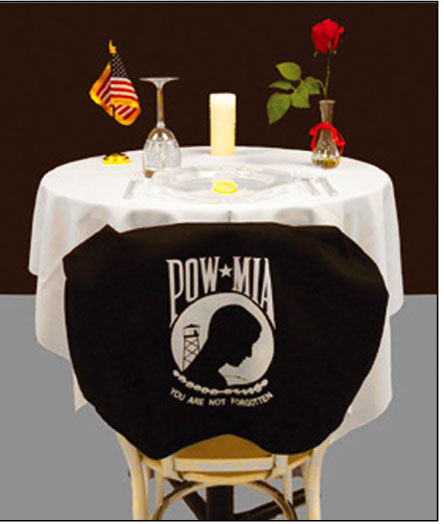
The typical items required for a remembrance service:
More table settings and symbolic items are used in a remembrance ceremony, as this ritual typically honors all five branches of the armed forces.
POW/MIA remembrance service full script:
Those who have served, and those currently serving the uniformed services of the United States are ever mindful that the sweetness of enduring peace always has been tainted by the bitterness of personal sacrifice. We are compelled to never forget that while we enjoy our daily pleasures, there are others who have endured and may still be enduring the agonies of pain, deprivation, and internment.
Before we begin our activities this evening, we will pause to remember our prisoners of war and missing in action.
We call your attention to this small table, which occupies a place of dignity and honor near the head table. It is set for one–symbolizing the fact that our armed forces personnel are missing from our ranks. They are referred to as POWs and MIAs.
We call them comrades. They are unable to be with their loved ones and families tonight, so we join together to pay our humble tribute to them, and to bear witness to their continued absence.
The table is small, symbolizing the frailty of one prisoner, alone against his or her oppressors.
The tablecloth is white, symbolic of the purity of intentions to respond to their country’s call to arms.
The single rose in the vase signifies the blood they may have shed in sacrifice to ensure the freedom of our beloved United States of America. This rose also reminds us of our missing comrades’ families and friends who keep the faith while awaiting their return.
The red ribbon on the vase represents the red ribbons worn on the lapels of thousands who demand with unyielding determination a proper accounting of our comrades who are not among us tonight.
A slice of lemon on the plate reminds us of their bitter fate.
The salt sprinkled on the plate reminds us of the countless fallen tears of families as they wait.
The glass is inverted;they cannot toast with us at this time.
The chair is empty; they are not here.
The candle is reminiscent of the light of hope, which lives in our hearts to illuminate their way home, away from their captors, to the open arms of a grateful nation.
The American flag reminds us that many of them may never return and have paid the supreme sacrifice to insure our freedom.
Let us pray to the Supreme Commander that all of our comrades will soon be back within our ranks.
Let us remember and never forget their sacrifice.
May God forever watch over them and protect them and their families.


